
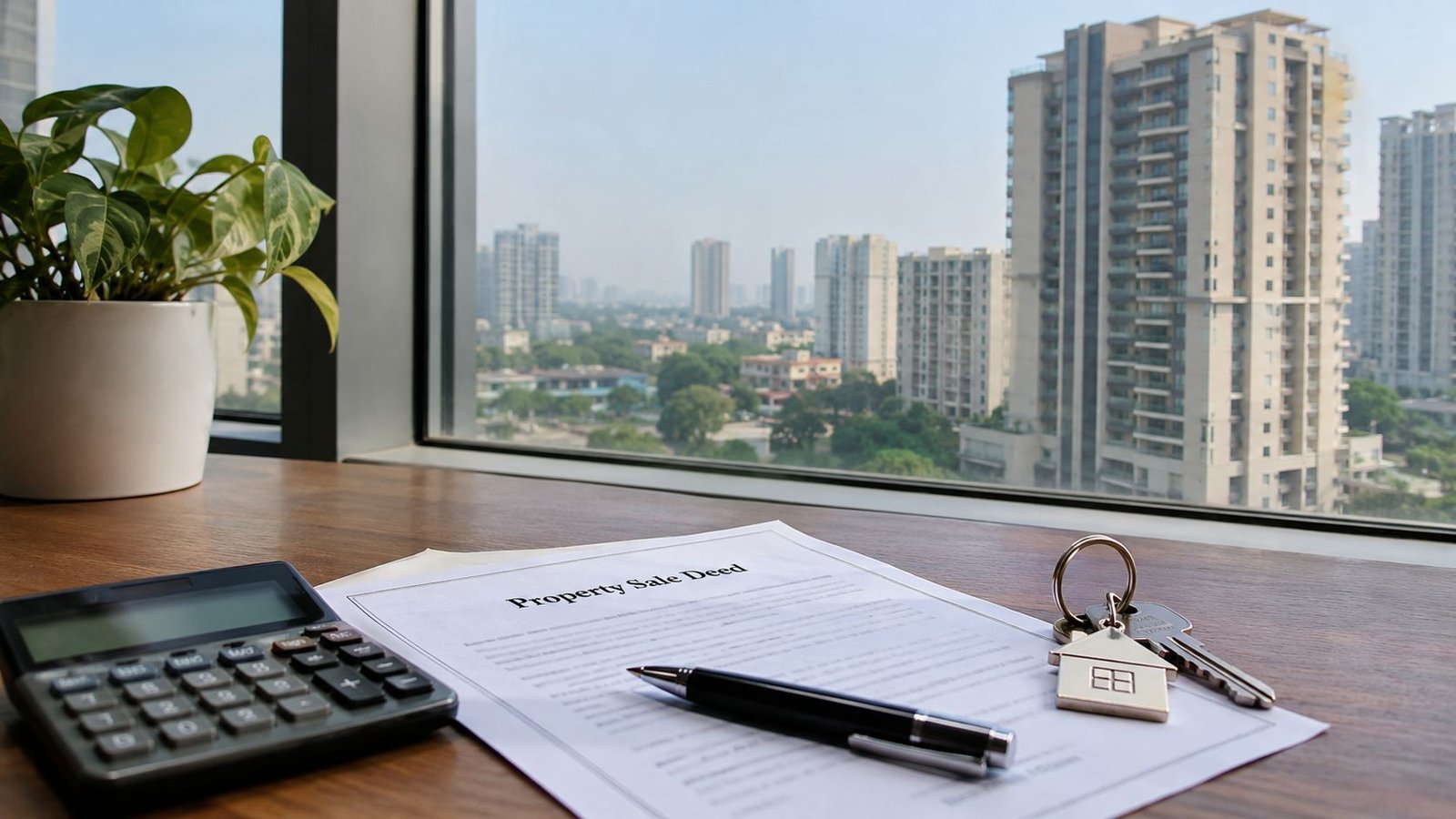
An illustrative representation of property paperwork and registration costs in Gurugram.
Circle rates are the government’s minimum property values, and stamp duty is charged on whichever is higher: your sale price or the circle value. After the 2026-27 revision, many Gurugram buyers are paying duty on a bigger number than the one on their agreement.
Key facts
- What: circle (collector) rates, the minimum value used to calculate stamp duty and registration charges
- Revision: 2026-27 rates, reported as effective from 1 April 2026
- Range: increases of 15 to 30 per cent in many areas, up to 75 per cent in some high growth pockets
- Stamp duty (urban): 7 per cent for men, 5 per cent for women and 6 per cent for joint ownership
- Where to check: the collector rates on the Haryana property registration portal and the Gurugram district website
Gurugram’s district administration revised its collector rates for 2026-27 in the spring. Hindustan Times reported that the new rates took effect on 1 April, with most areas seeing 15 to 30 per cent increases and some reaching 75 per cent. We reported the headline on 14 November in our earlier story on the circle rate hike. This explainer covers what the number does to your registry bill.
What a circle rate is and why it matters
A circle rate is the minimum value the government fixes for a property in a sector, village or colony. It is the floor for registration. If you buy below it, the registry is still calculated on the circle value.
Stamp duty and registration charges are applied on the circle rate or the agreement value, whichever is higher. A rate rise can therefore raise your costs even when the seller’s price has not moved.
What you pay on top of the price
The stamp duty rates for sale deeds in Haryana depend on whether the property is within municipal limits and on the buyer’s gender. Registration is a separate charge of 1 per cent, with a minimum of Rs 1,000.
| Property location | Male buyer | Female buyer | Joint |
|---|---|---|---|
| Urban (municipal limits) | 7% | 5% | 6% |
| Rural (outside limits) | 5% | 3% | 4% |
Registration charge: 1 per cent of the value, minimum Rs 1,000. Confirm current rates with the sub-registrar before you sign.
Here is how a higher circle value changes the bill. The figures below are an illustration, not a real transaction. A male buyer in an urban sector agrees a price of Rs 1 crore, but the circle value of the property is Rs 1.2 crore.
| Charge | On Rs 1 crore price | On Rs 1.2 crore circle value |
|---|---|---|
| Stamp duty (7%) | Rs 7 lakh | Rs 8.4 lakh |
| Registration (1%) | Rs 1 lakh | Rs 1.2 lakh |
| Total | Rs 8 lakh | Rs 9.6 lakh |
Hypothetical values. The buyer pays on the higher figure, so the bill is Rs 9.6 lakh, Rs 1.6 lakh more than the price alone would suggest.
Where rates rose most
The Tribune reported that the steepest increases were concentrated where connectivity has improved. District Revenue Officer Vijay Yadav said the largest hikes were in areas benefiting from better connectivity.
| Area | Reported change |
|---|---|
| Dwarka Expressway, Sectors 104 to 115 (plots) | About 62 to 67 per cent |
| DLF Phases 1 to 5 | 45 to 75 per cent |
| Sectors 58 to 63 (Wazirabad tehsil) | 25 to 75 per cent |
| Golf Course Road, Sectors 42, 43 and 54 | 10 to 20 per cent |
| Agricultural land (Bajghera and Sarhaul villages) | Up to 145 per cent |
Source: The Tribune. Dwarka Expressway, Golf Course Road and agricultural figures are from the proposed 2026-27 rates published in March. DLF and Wazirabad figures are from the announced rates. Check the notified rate for your sector.
How to check your sector’s rate
- Open the Property Registration section of the Haryana government portal and choose Collector Rates.
- Select the district, tehsil, village or sector.
- Read the rate for your category, such as residential plot, flat or commercial.
- Multiply it by your area and compare the result with your agreement value. The higher figure is what duty is charged on.
Budget for stamp duty and registration on the circle value, not just the price you negotiate. Ask the seller or broker for the circle value before you fix the budget. Buyers near the Dwarka Expressway and the proposed metro expansion routes should expect the largest gaps. For another angle on that corridor, read our report on the Sector 33 metro depot bid.
Common questions
Can I register below the circle rate?
You can sign a lower price, but duty is still calculated on the circle value because it is the higher figure.
Do women pay less?
Yes. In urban areas the stamp duty is 5 per cent for a woman buyer against 7 per cent for a man, and 6 per cent for joint ownership.
Does a rate rise change my sale price?
Not directly. The circle rate sets the legal floor for registration. Market price is still agreed between buyer and seller, though a higher floor can narrow the gap between the two.
Sources: Collector rates for Gurugram 2026-27 and Haryana stamp duty and registration rules, as reported by The Tribune, Hindustan Times and published property rate guides. Rates should be confirmed with the Gurugram district administration and the sub-registrar.