
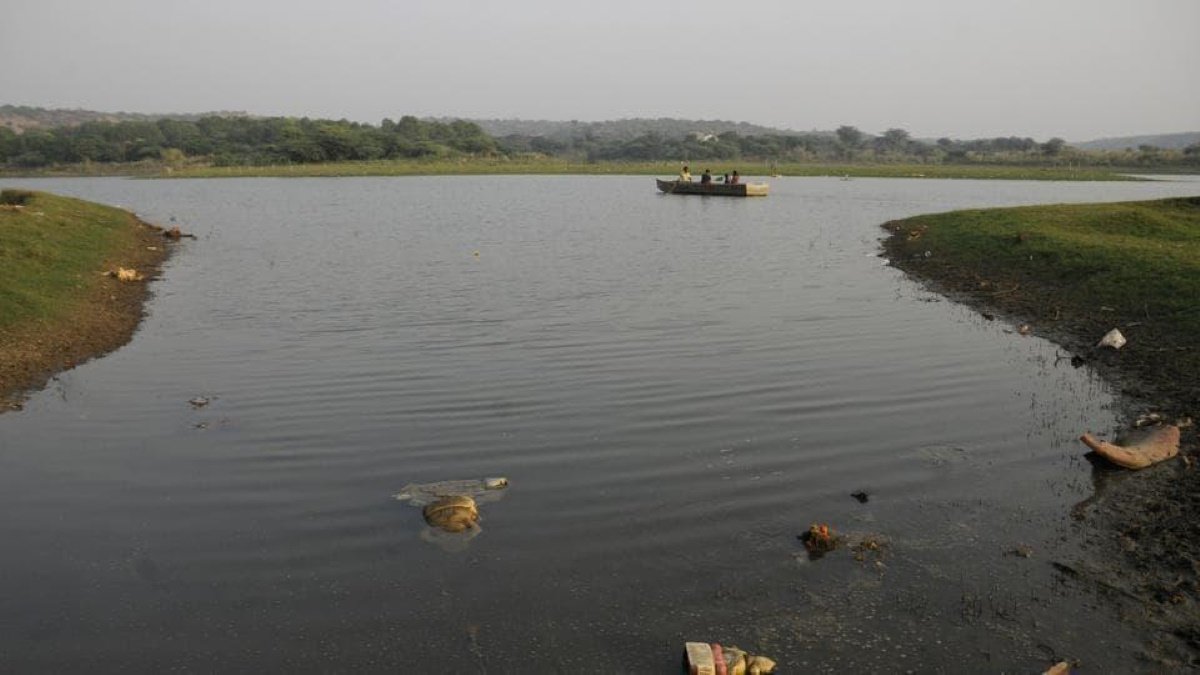
Gurugram’s Damdama Lake has lost 95% of its mapped area since 1993, with declining groundwater levels, damaged drainage channels and encroachments adding to the pressure. At the same time, authorities are exploring a rainwater-storage and dam proposal near the lake, including the possibility of generating electricity. A THDC team has inspected the site, but no construction approval has been confirmed.
Damdama Lake, one of the important freshwater bodies in the Aravalli foothills near Sohna, is facing a major ecological challenge. A recent assessment reported by The Times of India found that the lake’s mapped area has fallen from 153.6 acres in 1993 to just 7.9 acres in 2026, a reduction of around 95% over three decades.
The shrinking waterbody is not facing a single problem. Falling groundwater levels, changes in the surrounding landscape, construction activity, mining and disruption of natural rainwater channels have all contributed to the decline.
Why is Damdama Lake shrinking?
According to the assessment cited by TOI, the lake’s present catchment covers approximately 24.5 square kilometres. The waterbody has also fragmented into five smaller sub-basins instead of remaining one connected lake.
A 2025 assessment identified 22 depressions in the surrounding landscape where rainwater now collects instead of flowing towards the lake. Construction and mining activity have altered parts of the natural drainage system.
A road and a culvert in the catchment have also blocked two drainage channels. The road, which was earlier around 1.5 km long, has affected the natural route through which rainwater reached the lake.
A 2023 assessment by TERI School of Advanced Studies had estimated the lake’s water spread at around seven hectares. It also highlighted groundwater extraction in nearby areas. The study mapped public water-supply borewells in Damdama, Abheypur and Kherla, raising concerns about pressure on local groundwater resources.
Dam and power-generation proposal near Damdama Lake
While the lake faces environmental pressure, a separate proposal to store rainwater near Damdama Lake is also being explored by authorities as part of a wider effort to address Gurugram’s monsoon waterlogging.
According to reports published by Hindustan and other newspapers, a plan is being examined to construct a reservoir near the lake, potentially using the natural landscape between two hills. The proposal involves diverting rainwater from different parts of Gurugram towards storage areas near Damdama.
The Tehri Hydro Development Corporation (THDC) team has inspected the site to examine the possibility of power generation. The team has also sought information related to the lake from the Gurugram Metropolitan Development Authority (GMDA) and the Forest Department.
The wider proposal includes developing additional water-storage bodies, drainage infrastructure and a possible tunnel to transport rainwater towards the Damdama area. Electricity generation through a pumping-based system is among the possibilities being examined.
However, residents should understand the current status clearly. A site inspection and a feasibility exercise do not amount to approval for construction. No formal construction approval, confirmed work-start date or final project clearance could be independently verified at the time of publication.
Earlier lake restoration plan also awaits approval
The lake’s restoration has been discussed separately in the past. A tripartite agreement involving GuruJal, Haryana State CSR Trust and EY Foundation was signed in December 2022 for a proposed restoration initiative and biodiversity park covering around 500 acres across Damdama, Abheypur and Kherla.
The plan included catchment treatment, native plantation, a green corridor, groundwater recharge measures and desilting. However, TOI reported that the restoration proposal was still awaiting government approval, with a significant portion of the lake land falling under the Forest Department.
Damdama Lake is connected to the wider Aravalli drainage and groundwater system. Any future water-storage or infrastructure project will need to be assessed alongside the protection of natural drainage channels, the catchment and the lake’s ecological condition. The proposed dam should not be confused with an approved construction project.
Sources: The Times of India, November 21, 2026, for the lake’s shrinking area and ecological assessment; Hindustan Times, November 25, 2026, for the reservoir proposal; Live Hindustan, November 24, 2026, for the THDC site inspection; The Tribune, November 11, 2026, for the wider rainwater-storage plan and earlier government inspection.