
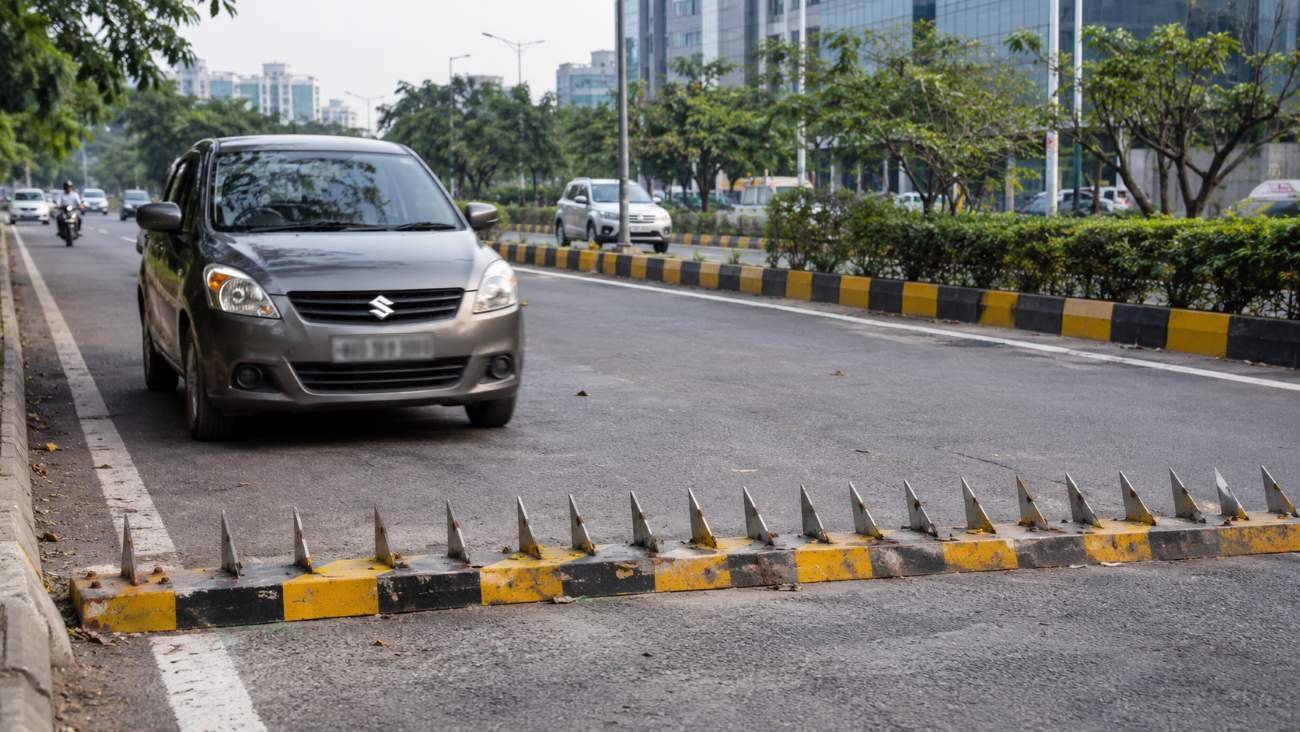
Cities from Jaipur to Varanasi are using spike barriers to stop wrong-side driving. Gurugram issues thousands of challans for the same offence every month but the problem persists. We look at whether tyre killers are a fix or just another quick experiment.
Key facts
- What: Spike barriers (tyre killers) punish wrong-side driving by puncturing tyres of vehicles going against traffic
- Where tried: Jaipur, Varanasi, Noida, Pune, Thane, Ahmedabad, Lucknow, Bengaluru
- Gurugram context: Traffic police issued 19,146 challans worth Rs 99.42 lakh in a single month for wrong-side driving
- Key concern: Pune and Noida removed their tyre killers within weeks; Indian Road Congress has not approved the device
Jaipur’s railway station area and Varanasi’s main roads are the latest places in India to get tyre killers, the spike-based barriers that flatten tyres of any vehicle that enters a one-way stretch from the wrong direction. The idea is simple: fines have not worked, so make the road itself the enforcer.
Gurugram has the same problem in sharper form. Traffic police here issued 19,146 challans worth Rs 99.42 lakh for wrong-side driving in a single month this year, one of the largest single-offence crackdowns in the city’s recent history. The fines are going up. The violation rates are not going down.
How tyre killers work
A tyre killer is a metal strip fixed across a road. It has a ramp on one side and spikes on the other. Vehicles travelling in the correct direction roll over the ramp and feel nothing more than a mild bump. Any vehicle coming from the opposite direction drives into the spikes and gets its tyres punctured.
The design is intended to be self-enforcing: no camera, no challan, no officer needed at the spot.
What happened when other cities tried it
The record in India is not clean. Pune was the first Indian city to install tyre killers, near Amanora Park Town, but Pune Police issued a legal notice and had them removed within a month. The Indian Road Congress has not approved the device for use on public roads, citing safety risks.
Noida, the closest NCR parallel to Gurugram, installed tyre killers at the Sector 76-77 intersection and later removed them too. Reports from Ahmedabad showed the spring-loaded spikes were retracting even when vehicles came from the wrong side, making the device ineffective in practice.
In Thane, spike barriers installed near a railway station led to pedestrian injuries and local protests. Residents there pointed out that footpaths were too narrow, forcing people to walk on the road directly into the spikes.
Lucknow Police installed tyre crushers this year and Bengaluru’s traffic joint commissioner announced a trial at ten junctions. Both are being watched for results.
Gurugram Traffic Police have identified 80 spots in the city where vehicles regularly drive against traffic. NH-48 service lanes, Golf Course Extension Road and the Gurugram-Faridabad Road are among the most cited. Wrong-side driving is classified as dangerous driving under the Motor Vehicles Act and can attract a fine of up to Rs 5,000 and, since January 2026, an FIR.
The case for Gurugram
Proponents would point to the numbers. The city’s 80 known wrong-side hotspots are a ready map of where barriers could go first. Some stretches, particularly internal sector roads and service lanes alongside expressways, have a fixed entry point that makes a tyre killer physically feasible.
Commuters on the ground have long argued that the problem is partly structural: some U-turns on key roads are placed up to two kilometres apart, leaving drivers with an inconvenient legal route or a quick illegal shortcut. At those spots, a tyre killer would be doing enforcement work that better road design should have done already.
If Gurugram Traffic Police or GMDA were to trial tyre killers, it would likely start at one or two of the 80 identified hotspots. Drivers using those stretches the wrong way would face tyre damage with no advance warning. Pedestrians who walk on those roads because footpaths are blocked or absent could also be at risk, as happened in Thane.
The case against
The legal status of tyre killers on public roads in India remains unresolved. The Indian Road Congress, which sets road design standards, has not approved the device. Any authority installing one on a public road does so without that backing, which creates liability if a vehicle is damaged or a person is injured.
Gurugram’s pedestrian infrastructure also carries the same gap that caused the Thane protests. Many roads in the city lack functional footpaths, and narrow or encroached pavements push walkers onto the carriageway regularly.
The technical failure seen in Ahmedabad, where spikes retracted for wrong-side vehicles due to mechanical wear or poor calibration, is a separate risk. A device that stops working looks worse than no device at all.