
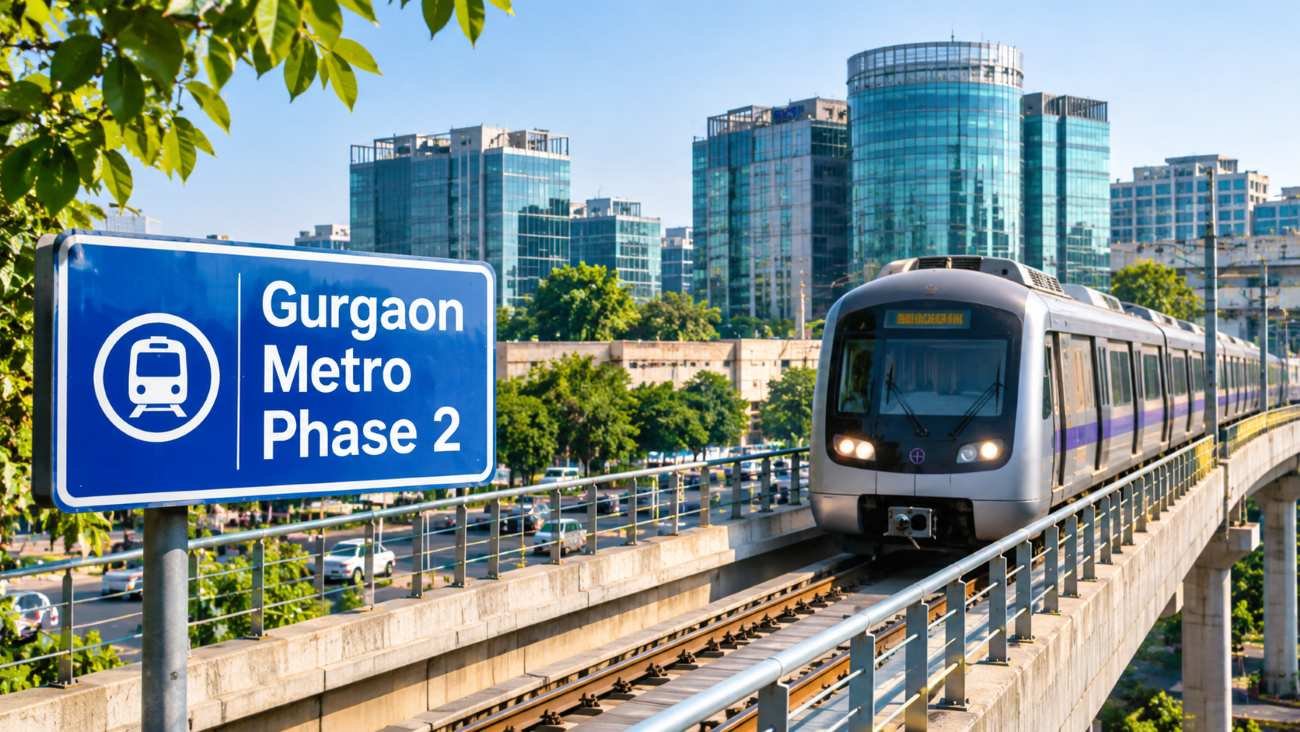
Gurgaon’s proposed Metro Phase 2 is beginning to take clearer shape, with planning activity and right-of-way discussions indicating that the long-delayed expansion may finally move toward execution. While timelines remain fluid, the alignment being discussed suggests a significant shift in how large parts of the city connect to its primary business districts.
The expansion is expected to strengthen links between older sectors of Gurgaon and the established corporate hubs around Cyber City and Udyog Vihar, while also intersecting with emerging residential corridors along the Dwarka Expressway. For a city that has long relied on road-based commuting, this is not just an infrastructure upgrade but a potential reset of daily mobility patterns.
Old Gurgaon could see the biggest structural change
Sectors such as 9, 9A, 10 and 10A, which have historically lacked direct metro access, are likely to see the most immediate lifestyle impact. These neighbourhoods have dense residential populations and established local markets, but connectivity has remained dependent on shared autos, buses and private vehicles.
If metro access becomes available within walking or short commuting distance, travel times to Cyber City and other employment centres could reduce sharply. This may also make these areas more viable for younger working professionals who have so far preferred newer sectors with better connectivity.
Over time, this shift could reflect in rental demand first, followed by gradual capital appreciation in older housing stock that has seen relatively slower growth compared to new Gurgaon.
Dwarka Expressway belt may emerge as the biggest beneficiary
The stretch covering Sector 37 and surrounding areas along the Dwarka Expressway is already positioned as one of Gurgaon’s fastest-growing real estate corridors. Large-scale residential and commercial developments are underway, but public transport connectivity has not kept pace with this expansion.
A metro link through or near this belt could significantly accelerate its growth trajectory. Improved access to both Delhi and core Gurgaon business districts would make the location more attractive for end users as well as investors. In real estate terms, infrastructure certainty often precedes price movement, and this corridor is likely to respond quickly once execution timelines become clearer.
Peripheral areas like Basai may see long-term transformation
Areas such as Basai, which currently sit on the edge of Gurgaon’s urban expansion, may not see immediate gains but could benefit over a longer horizon. Metro connectivity tends to trigger follow-on infrastructure such as road upgrades, commercial activity and formal housing development.
For these pockets, the impact is less about instant price movement and more about gradual urban integration. As connectivity improves, land use patterns often evolve, bringing in new residential demand and small-scale commercial growth.
Corporate hubs could see relief from daily congestion
Cyber City and Udyog Vihar, which together form the core of Gurgaon’s office economy, continue to face heavy congestion during peak hours. A stronger metro network feeding into these zones could ease pressure on arterial roads and reduce commute uncertainty for a large section of the workforce.
For companies, improved employee mobility often translates into better productivity and wider hiring catchments. For commuters, it reduces dependence on unpredictable road travel, particularly during monsoon months or peak traffic cycles.
A familiar concern: execution timelines
While the potential benefits are clear, Gurgaon’s infrastructure history suggests that execution will be closely watched. Delays linked to land acquisition, inter-agency coordination and funding approvals have affected several past projects.
Construction, once it begins, is also likely to bring short-term disruption, particularly in already congested stretches. However, if timelines are maintained, the long-term gains could outweigh these temporary inconveniences.
A shift that goes beyond transport
Metro Phase 2 is likely to influence more than just commuting patterns. It could reshape residential preferences, redistribute rental demand and alter the relative attractiveness of different sectors within Gurgaon.
Older neighbourhoods may regain relevance, emerging corridors could accelerate faster than expected, and daily travel across the city may become more predictable than it has been in years.
For a city that has expanded rapidly but unevenly, the success of this phase will ultimately depend not just on where the tracks are laid, but on how efficiently the project moves from plan to reality.